
At-risk customer detection
Identify At-Risk Customers Before They Become Inactive
The best time to keep a customer is before they are gone. Revenow reads your transaction history, flags customers who are overdue for a purchase, and shows which of them deserve attention first.
The Problem: Customers Go Quiet Before They Leave
Very few customers stop buying overnight. There is usually a gap first: the next order doesn't arrive when it normally would, and nobody notices because there is nothing to notice. By the time the account is clearly lost, the easiest moment to act has passed.
At-risk customer software turns that silent gap into a visible list, so your team can step in while the relationship is still warm.
Why Early Warning Matters
- A short reminder costs far less than a full win-back campaign.
- Customers who bought recently still remember you and your product.
- Acting early protects revenue that has not been lost yet.
How Revenow Identifies At-Risk Customers
Revenow applies one fixed set of rules, Generic 1.0, to every customer, counting days since the last purchase relative to the analysis reference date:
Active
Less than 60 days since the last purchase.
At risk
60 to 89 days since the last purchase. This is the early-warning group this page is about.
Inactive
90 days or more. These customers are covered in inactive customer detection.
A Practical Example
Illustrative example with hypothetical figures. Actual results depend on your data, and estimates are not guaranteed revenue.
Say your analysis reference date is 30 June. A customer who last ordered on 20 April is 71 days out, so Revenow marks them at risk. A customer who ordered on 15 May (46 days) is still active, and one whose last order was in February is inactive.
If the at-risk customer has a strong spending history, they move near the top of your list, with the revenue they represent shown as revenue at risk, separate from recoverable revenue.
Prioritize Who Needs Attention
Revenow ranks customers using signals such as:
- Historical spend
- Purchase frequency
- Purchase recency
- The estimated revenue involved
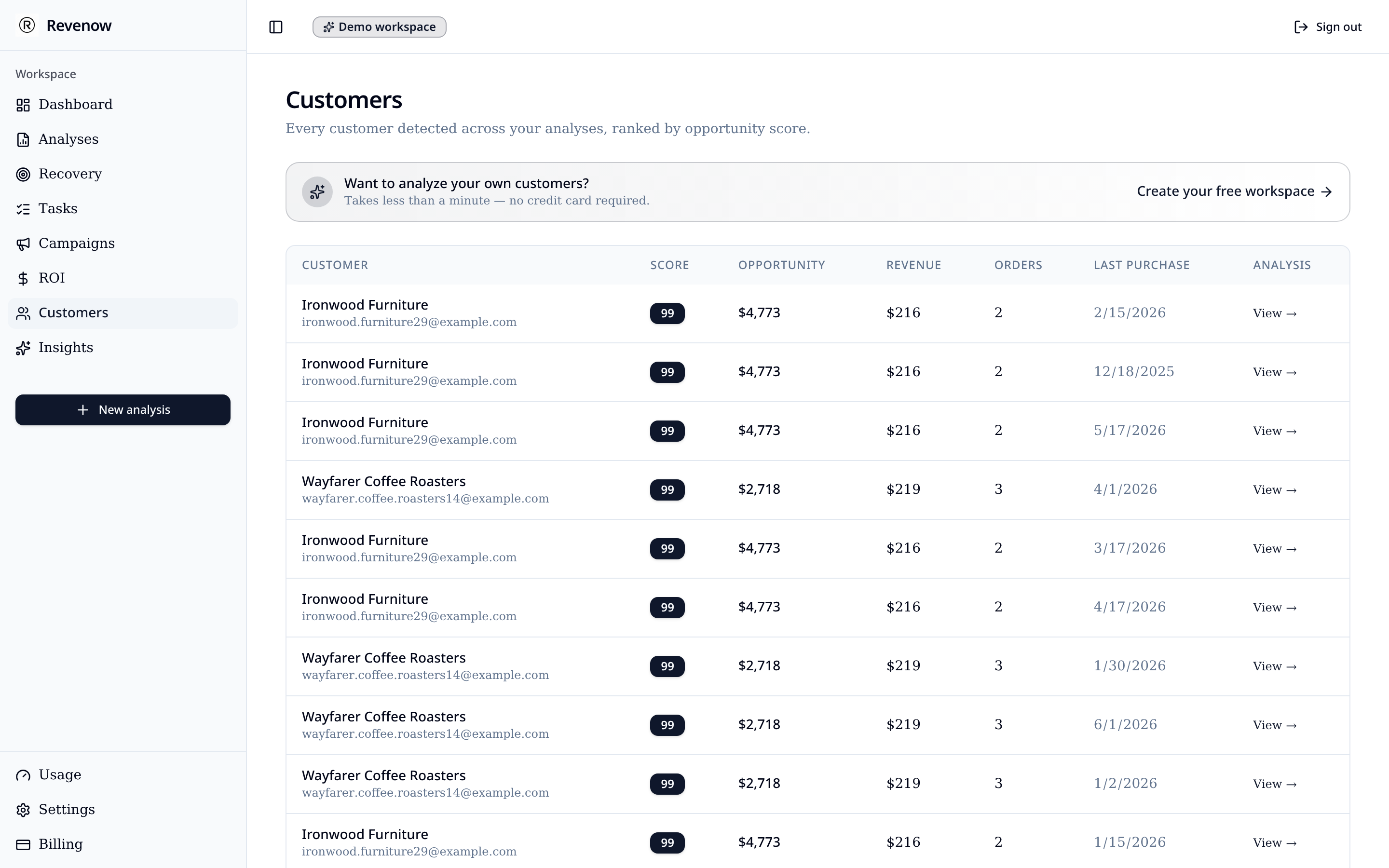
To see the money side of this group, read about revenue at risk analysis.
Who Benefits
- Online stores with repeat buyers of consumables or refills
- Wholesale and B2B sellers with regular reorders
- Account managers who need a short, ranked call list
Frequently Asked Questions
What makes a customer "at risk" in Revenow?
A customer is at risk when 60 to 89 days have passed since their last purchase, measured from the analysis reference date. Under 60 days counts as active; 90 days or more counts as inactive.
Is "at risk" a prediction that the customer will leave?
No. It is a factual status based on time since the last purchase, applied with the same rules to every customer. It flags who to look at, not who will definitely stop buying.
Why focus on at-risk customers instead of inactive ones?
At-risk customers have not crossed the inactivity threshold yet, so they are often easier to re-engage. Inactive customers need a win-back conversation; at-risk customers usually need a timely reminder.
How does Revenow decide which at-risk customers come first?
Revenow ranks opportunities using signals such as historical spend, how often the customer bought and how recently they were active, together with the estimated revenue involved.
Does Revenow contact at-risk customers for me?
No. Revenow identifies and prioritizes them. You decide how and when to reach out using your own email, phone or sales tools.
See what each plan includes on the pricing page.