
Revenue at risk analysis
Identify Revenue at Risk Before Customers Stop Buying
Knowing which customers are slipping is useful. Knowing how much revenue they represent is what gets a plan approved. Revenow puts an estimated figure on the exposure, while it can still be protected.
The Question Behind Revenue Risk
When a few customers stop ordering, the real question is the cost: does it matter, and how much? Customer revenue risk is rarely tracked because accounting tools record what was sold, not what you might be about to miss.
What Revenue at Risk Means Here
Revenow counts days since each customer's last purchase relative to the analysis reference date, with one fixed rule set (Generic 1.0) for everyone. Customers with 60 to 89 days are at risk, and the estimated value tied to them is your revenue at risk.
Keep these figures apart:
- Estimated revenue at risk: at-risk customers, not lost yet.
- Estimated recoverable revenue: inactive customers, 90 days or more.
- Recognized revenue: what your books record. Revenow doesn't change it.
- Recovered revenue: only what customers actually spend after you act.
Why It Matters
A figure turns a vague worry into a decision. If revenue at risk is small, a light reminder may be enough. If a few large accounts make up most of it, they deserve a personal call.
How Revenow Estimates It
For every at-risk customer, Revenow takes their average order value, multiplies it by the purchase cycles they have missed, and weights it by how likely they are to return based on past spend and purchase frequency. The same calculation runs every time, and amounts stay in their original currency.
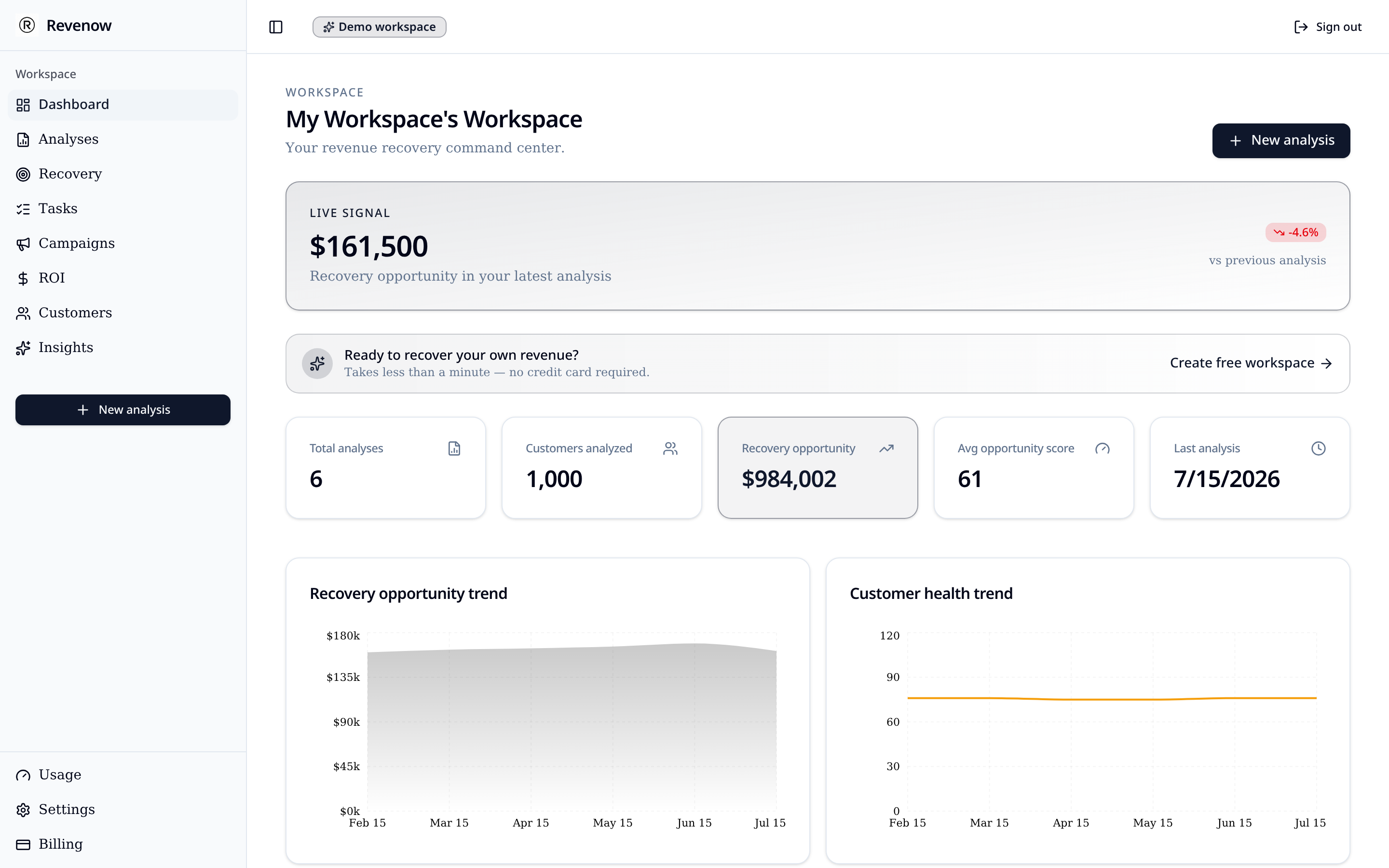
Example: Where the Exposure Sits
Illustrative example with hypothetical figures. Actual results depend on your data, and estimates are not guaranteed revenue.
An analysis finds 90 at-risk customers. Most have small order values, but eight wholesale accounts carry the majority of the estimated revenue at risk. Instead of emailing all 90 the same message, the team starts with those eight.
Prioritize the Opportunities
Revenow ranks opportunities so the largest and most promising sit at the top. To work the customer list itself, see at-risk customer detection.
Who Benefits
- Owners and finance leads who want to size customer risk
- Sales managers deciding where account time goes
- Teams building a case for retention budget
Frequently Asked Questions
What is revenue at risk in Revenow?
An estimate of the value tied to at-risk customers: those with 60 to 89 days since their last purchase, measured from the analysis reference date. It covers revenue that is not lost yet.
How is revenue at risk different from recoverable revenue?
Revenue at risk covers at-risk customers only. Estimated recoverable revenue covers inactive customers only (90 days or more). The two are calculated the same way but always reported separately.
Is revenue at risk a forecast of losses?
No. It is an estimate of exposure, not a guaranteed future loss. Some at-risk customers will buy again on their own.
Is it the same as recognized revenue in my accounts?
No. It is not booked or recognized revenue and should not be used for financial reporting. It is a prioritization figure.
How is the estimate calculated?
From each customer's past purchases: their average order value and the purchase cycles they have missed, weighted by how likely they are to return based on their spend and how often they used to buy.
Compare plans on the pricing page.